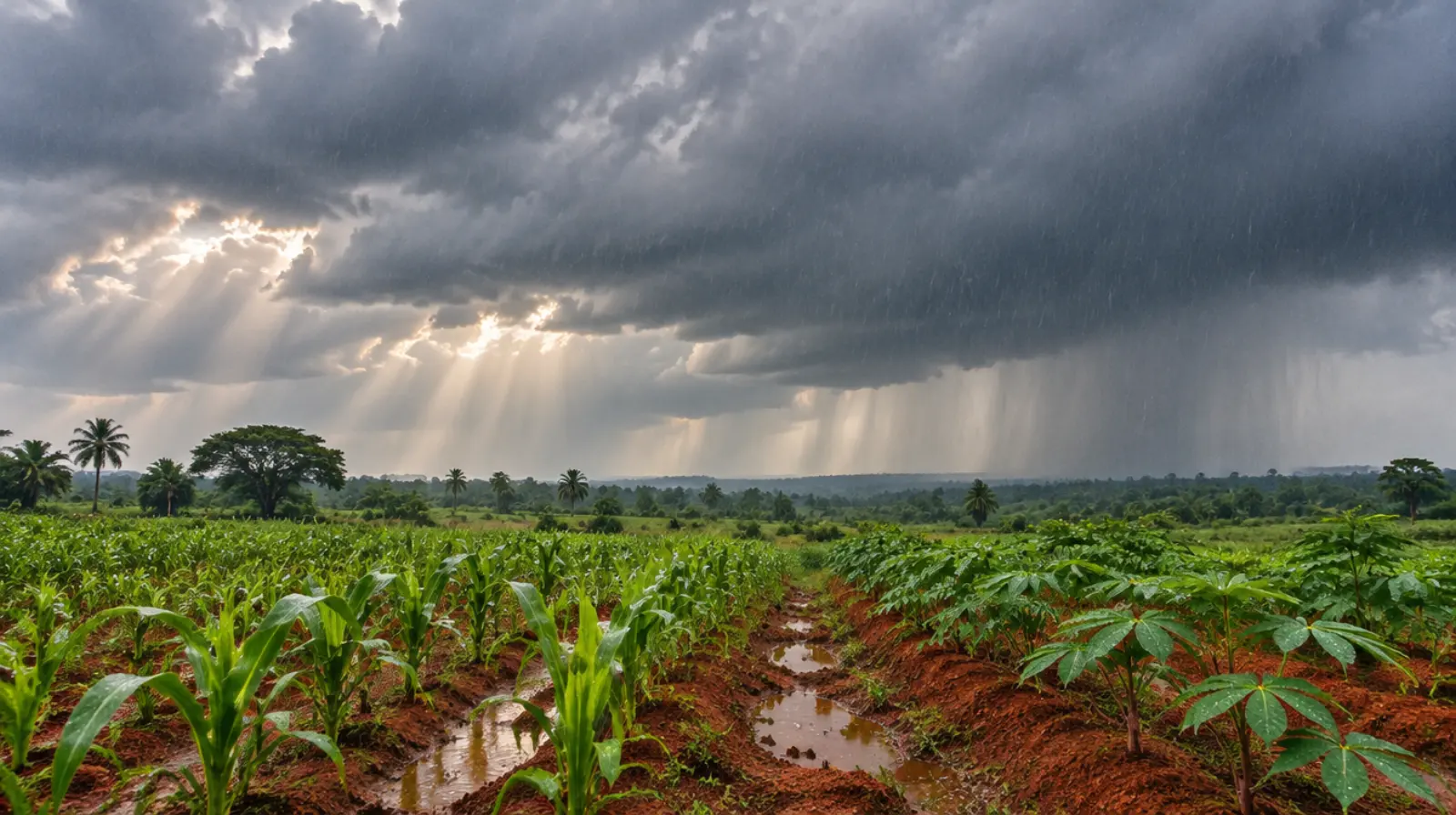
Rainfall cover,
priced by a market
Assessing a two-hectare farm costs more than the policy is worth, so smallholders cannot buy drought cover. Mmiri removes the assessor: five underwriter agents bid against each other for the risk, and the rainfall record settles it.
Rainfall in this window, 1981–2025
See the 45 figures behind this chart
| Season | Total | Outcome |
|---|---|---|
| 1981 | 192.4 mm | No payout |
| 1982 | 117.4 mm | No payout |
| 1983 | 90.1 mm | No payout |
| 1984 | 121.7 mm | No payout |
| 1985 | 190.0 mm | No payout |
| 1986 | 102.3 mm | No payout |
| 1987 | 108.5 mm | No payout |
| 1988 | 169.8 mm | No payout |
| 1989 | 169.5 mm | No payout |
| 1990 | 165.3 mm | No payout |
| 1991 | 157.9 mm | No payout |
| 1992 | 163.3 mm | No payout |
| 1993 | 154.4 mm | No payout |
| 1994 | 140.5 mm | No payout |
| 1995 | 191.2 mm | No payout |
| 1996 | 180.4 mm | No payout |
| 1997 | 153.4 mm | No payout |
| 1998 | 132.7 mm | No payout |
| 1999 | 31.2 mm | Paid |
| 2000 | 154.6 mm | No payout |
| 2001 | 96.4 mm | No payout |
| 2002 | 54.7 mm | Paid |
| 2003 | 124.9 mm | No payout |
| 2004 | 42.6 mm | Paid |
| 2005 | 161.8 mm | No payout |
| 2006 | 20.6 mm | Paid |
| 2007 | 144.8 mm | No payout |
| 2008 | 89.5 mm | No payout |
| 2009 | 102.9 mm | No payout |
| 2010 | 122.6 mm | No payout |
| 2011 | 67.0 mm | No payout |
| 2012 | 184.2 mm | No payout |
| 2013 | 52.0 mm | Paid |
| 2014 | 90.5 mm | No payout |
| 2015 | 27.3 mm | Paid |
| 2016 | 101.9 mm | No payout |
| 2017 | 125.0 mm | No payout |
| 2018 | 66.7 mm | No payout |
| 2019 | 63.2 mm | Paid |
| 2020 | 132.7 mm | No payout |
| 2021 | 248.2 mm | No payout |
| 2022 | 114.3 mm | No payout |
| 2023 | 50.4 mm | Paid |
| 2024 | 87.1 mm | No payout |
| 2025 | 42.7 mm | Paid |
9 of 45 seasons since 1981 fell below 66.7 mm and would have paid. 5 of those 9 happened since 2011.
- Seasons that would have paidKano, every season on record since 1981
- 9of 45
- Driest window in the record2006 — against a 66.7 mm strike
- 20.6mm
- Underwriters competing for the riskeach with its own capital, its own key, and its own read
- 5
- Policies settled on testnetone of them by a TEE oracle reading NASA directly
- 3
How one round works
A sealed-bid auction, start to finish, in about two minutes on chain.
You ask for cover
One place, one 30-day window, your maximum price — escrowed with the request.
Agents bid blind
Each underwriter submits a hash of its premium. No one can read a rival's bid.
Bids are opened
After the window closes, each reveals. The contract rechecks every hash.
The lowest price wins
Cheapest premium under your maximum takes the risk, and locks the full payout.
Rainfall decides
The oracle reads NASA. Below the strike the payout moves — no claim is filed.
Markers sit at the coordinates the oracle sends to NASA. The country outline is a schematic. Pick one to reprice the page.
Eight places, eight different risks
Rainfall is local. Enugu and Maiduguri sit in different climates on the same map, and their windows do not even start in the same month — the south plants in April, the far north in June. A single national price would be wrong everywhere.
The market prices each site on its own record, so the premium follows the place rather than the country. Pick one on the map and every figure on this page recomputes for it.
Set your terms, then buy the cover
Change anything on the left and every figure recomputes from the committed rainfall record. The price on the right is what the market would charge you now.
What the five agents would quote
| Agent | Its view of the history | Breach rate | Load | Premium | % of payout |
|---|---|---|---|---|---|
| uw-1 Longrun would win | Every season since 1981 counts equally; the climate is noise around a mean. | 21.3% | 20% | 12.77 | 25.5% |
| uw-5 Capacity | Blend the views, then ration the last of the capital by charging more for it. | 28.3% | 20% | 16.97 | 33.9% |
| uw-3 Blend | Split the difference and charge a little more for not knowing which is right. | 28.3% | 25% | 17.68 | 35.4% |
| uw-2 Recent | Only the last 15 seasons tell you anything; the old ones are a different climate. | 35.3% | 20% | 21.18 | 42.4% |
| uw-4 Cautious | Price the worse of the two views. Survive first, compete second. | 35.3% | 35% | 23.82 | 47.6% |
Why this needs a market and not a formula
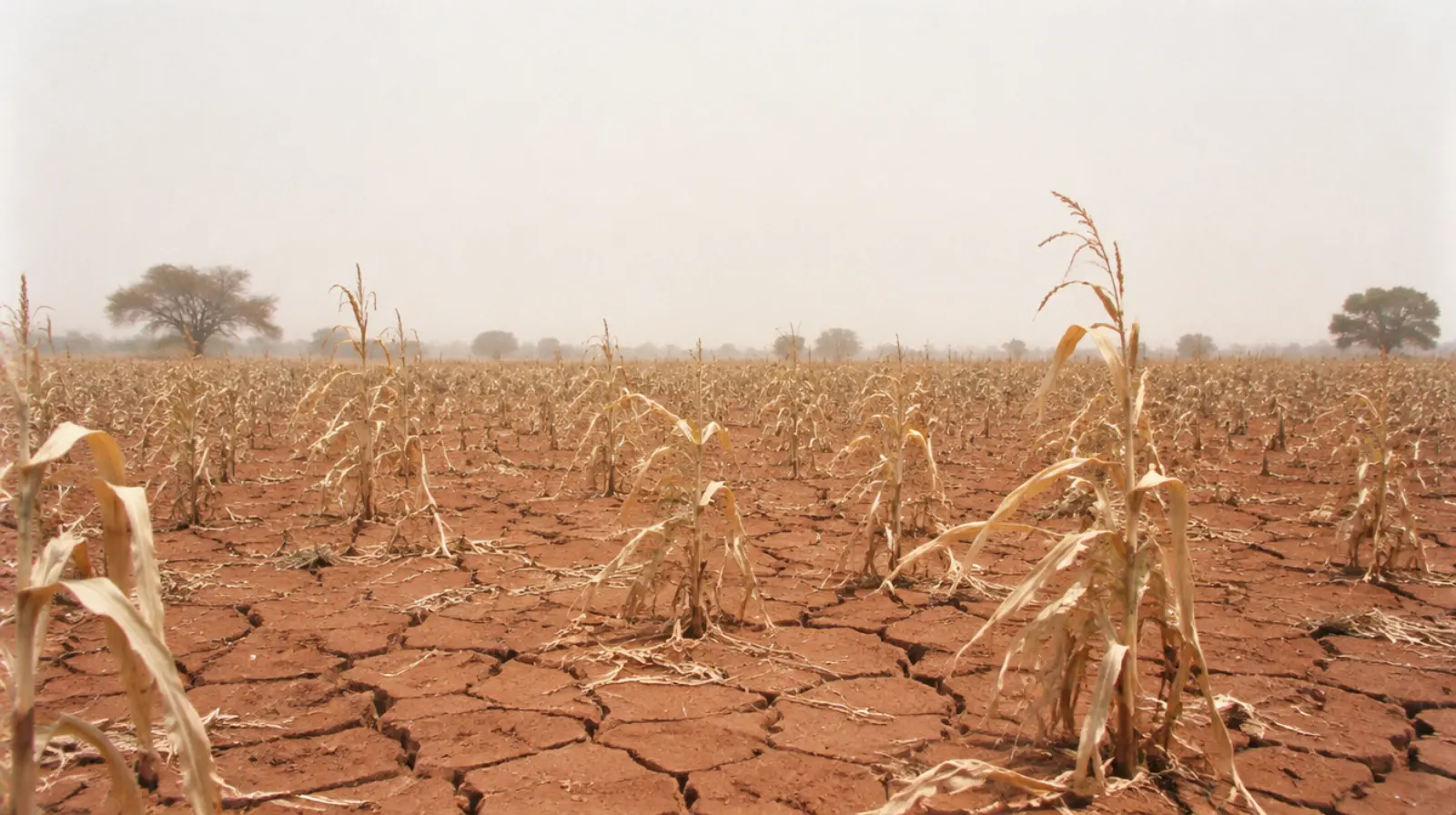
9 of the 45 seasons on record at Kano ended like the ground behind this text.
Both numbers are correct. They disagree, and the premium you should charge differs accordingly. No single formula can know which rate is right, because the question — how much does the distant past tell you about next season — is a real open question about a changing climate. So Mmiri does not pick. It runs an auction, and the underwriters that misprice the risk lose their own capital.
Settled on testnet, not described
Every one of these is a transaction you can open and a reading you can recompute yourself with pnpm verify-oracle.
Policy 7
Paid outbelow the 60.0 mm strike — 50 USDC went to the holder. Settled via the keeper path.
Policy 9
Paid outsettled by an OutLayer worker inside a TEE, not a trusted account. Settled via the OutLayer path.
Policy 8
Expiredwell above the strike — no payout, collateral released. Settled via the keeper path.